2028 does not introduce a blanket e-invoicing obligation for every business and every invoice. On 1 January 2028, the remaining transitional arrangements end for the domestic B2B transactions concerned. Some businesses already have to issue structured invoices from 2027; statutory exceptions remain. Businesses established in Germany generally have had to be able to receive e-invoices since 1 January 2025. Waiting until 2028 can therefore already leave you behind organisationally. The relevant provisions are § 14 UStG and § 27 paragraph 38 UStG; the obligation to receive e-invoices is explained by the Chamber of Commerce and Industry for Munich and Upper Bavaria.
Legal position as of: 4 November 2026. The dates below follow from existing law, rather than a forecast. This guide provides general guidance and does not replace a legal or tax assessment of an individual case.
Which companies are affected by the deadline?
First consider the transaction, rather than the legal form or number of employees. The e-invoicing requirement generally applies when a business supplies goods or services in Germany to another business for its business purposes, and both are established in Germany within the meaning of the law. A participating German permanent establishment may also be relevant. Freelance activities are not generally exempt. Invoices to private customers, however, fall outside this B2B obligation. The legal basis is § 14 paragraph 2 UStG.
Practical recommendation: sort your outgoing invoices by customer type, place of supply and tax treatment. A business serving both business and private customers does not need the same answer for every invoice. Separate requirements also need to be checked for public-sector customers; the B2B transition periods do not settle that question, as the Chamber of Commerce overview of e-invoicing explains.
2027 or 2028: When must you start sending e-invoices?
The following applies to transactions covered by the rules, unless a permanent exemption applies. § 27(38) UStG provides for three transition stages:
- Until 31 December 2026: For transactions carried out in 2025 and 2026, the statutory transition rule still allows paper invoices or, with the recipient’s consent, ordinary electronic invoices.
- In 2027: The general extension only applies if the invoice issuer’s total turnover in the previous year was no more than 800,000 euros. For 2027, the relevant year is therefore 2026.
- From 1 January 2028: This extension no longer applies to the relevant transactions carried out from that date. The special transitional option for EDI invoices that do not have the required structure also ends with 2027.
Exactly 800,000 euros is still within the threshold. The law says “no more than”, rather than “less than”. What matters is total turnover under § 19(2) UStG, rather than profit or business-to-business turnover alone. The date of supply and the statutory deadline for sending invoices also need to be considered; a later invoice date does not simply shift the relevant turnover period. Source: § 27(38) UStG.
Illustrative examples: An agency subject to the standard VAT regime with relevant total turnover of 920,000 euros in 2026 generally has to issue e-invoices for the services concerned from January 2027. A comparable business with turnover of 480,000 euros can still use the general extension for 2027. Both should test the changeover; only the second business has an extra transitional year. These examples do not replace a legal assessment of particular transactions.
These exceptions will remain important in 2028
Exemptions are not extended transition periods. They are based on their own provisions and must be checked separately:
- Small-business VAT exemption: For transactions exempt from VAT under § 19(1) UStG, § 34a UStDV continues to allow other forms of invoice. A small business subject to the ordinary VAT rules is therefore not automatically exempt.
- Small-amount invoices: § 33 UStDV allows other forms of invoice up to and including 250 euros in total, including VAT. However, this provision does not apply to supplies within the meaning of §§ 3c, 6a and 13b UStG; “under 250 euros” is therefore no universal exemption.
- Travel tickets: Tickets under § 34 UStDV may still be sent as other forms of invoice.
- Certain tax-free services: UStG § 14(2) excludes transactions exempt from VAT under § 4, numbers 8 to 29, from the invoice-issuing obligation set out there. This does not cover every VAT exemption.
Sources: §§ 33, 34 and 34a UStDV and § 14 paragraph 2 UStG. Important for businesses using the Kleinunternehmer scheme: the exemption from issuing e-invoices does not remove the obligation to receive incoming e-invoices. The Munich Chamber of Commerce expressly points this out.
A PDF export does not solve the format issue
An e-invoice contains structured, electronically processable data. An ordinary PDF or scan is not enough. Common formats are XRechnung and ZUGFeRD from version 2.0.1, except for the profiles MINIMUM and BASIC-WL. This does not mean that every file with a corresponding name is actually constructed correctly. Sources: § 14 paragraph 1 UStG and Chamber of Commerce Munich, acceptable formats.
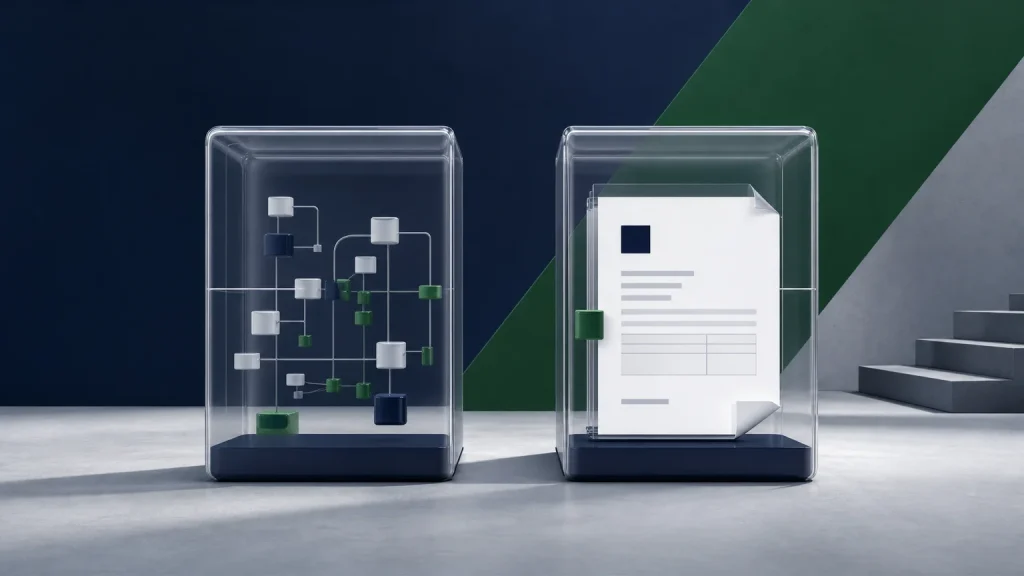
ZUGFeRD combines a PDF/A-3 file with embedded XML data. Checking the invoice therefore involves more than its visible image. FeRD describes the structured data as the authoritative part and recommends checks for conflicting content. A printed preview is no substitute for this data. Sources: FeRD, ZUGFeRD FAQ and Federal Chamber of Tax Advisers, questions 3.1 and 3.3.
Six steps to a reliable transition
The following steps are a practical recommendation, rather than an additional statutory deadline. Assign people to the work and check the results, instead of simply ordering software.
1. Document which requirements apply to your business
Create a one-page overview: customer groups affected, exemptions, relevant total turnover in 2026, the changeover date and outstanding tax questions. In particular, clarify activities that combine VAT-exempt and taxable supplies. The result should clearly state which invoice types need to be issued in a structured format from which date.
2. Check incoming invoices immediately
An email inbox is generally sufficient to receive e-invoices, but making them readable, checking them and storing them still need to be organised. Source: Munich Chamber of Commerce, software and receipt. Our recommendation: assign responsibility for the inbox and arrange cover for absences. Test whether XML attachments arrive, can be forwarded and can be found again. For practical guidance, see receiving invoices by email.
3. Test issuing invoices with real business cases
Ask your software provider for sample files in the intended format. Then test your own cases: several line items, discounts, different tax rates, corrections and, where applicable, an instalment invoice. Pay particular attention to the description and date of the supply. Decide who will complete missing master data and who will stop invoices being sent if errors occur. One successful example is not enough for acceptance testing.
4. Separate technical validation from business review
A format and business-rule check with a clear result is recommended. It does not replace checking the substance of the invoice: a technically valid data set can still contain an inadequate description of services. The Federal Chamber of Tax Advisers explains this distinction in questions 3.2 and 3.3. Match the order, evidence of the service and invoice, and define how objections are handled.
5. Secure the original file and make sure it can be found again
Under § 14b UStG, the retention period is generally eight years, beginning at the end of the year of issue. Keep the structured original file you received, not just a printout. Recommendation: test searching by invoice number, the link to the accounting entry and a data export for a future change of provider. The BStBK FAQ covers electronic retention and linking supporting documents.
6. Sign off a complete trial run
Follow a test invoice from creation and sending through to handover to accounting and finding it again later. Ask the person providing cover to run through the same steps. Document errors, who is responsible and how they were resolved. Our overview of processing e-invoices helps with the wider workflow; add automated follow-up steps once the basic process works reliably.
What to prioritise now
Recommendation as of November 2026: businesses above the relevant 800,000-euro threshold should now complete the switch for transactions covered from 2027. Businesses within the threshold should use 2027 for testing, rather than waiting. Businesses using the small-business VAT exemption should pay particular attention to incoming invoices. The key question is whether you can reliably receive or create a structured invoice, check it, retain it and produce it again later.
References
- Federal Ministry of Justice and Federal Office of Justice, Laws on the Internet: § 14 UStG – issuing invoices. Consolidated legal text; accessed: 04.11.2026.
- Federal Ministry of Justice and Federal Office of Justice, Laws on the Internet: § 27 UStG – general transitional provisions, in particular paragraph 38. Consolidated legal text; accessed: 04.11.2026.
- Federal Ministry of Justice and Federal Office of Justice, Laws on the Internet: VAT implementing regulation, in particular §§ 33, 34 and 34a. Consolidated legal text, as last amended by Regulation of 19.12.2025; accessed: 04.11.2026.
- Chamber of Commerce for Munich and Upper Bavaria: Electronic invoices (e-invoice), in particular receipt, transition periods, the Kleinunternehmer scheme and formats. Without a reliably stated publication date; accessed: 04.11.2026.
- Forum elektronische Rechnung Deutschland (FeRD): ZUGFeRD FAQs, in particular the structure of hybrid invoices and the authoritative structured data. No single publication date; accessed: 04.11.2026.
- Federal Chamber of Tax Advisors: FAQ on introducing mandatory e-invoicing for transactions between businesses established in Germany from 1 January 2025, as of 03.03.2026, in particular questions 3.1 to 3.4. accessed: 04.11.2026.
- Federal Ministry of Justice and Federal Office of Justice, Laws on the Internet: § 14b UStG – retention of invoices. Consolidated legal text; accessed: 04.11.2026.