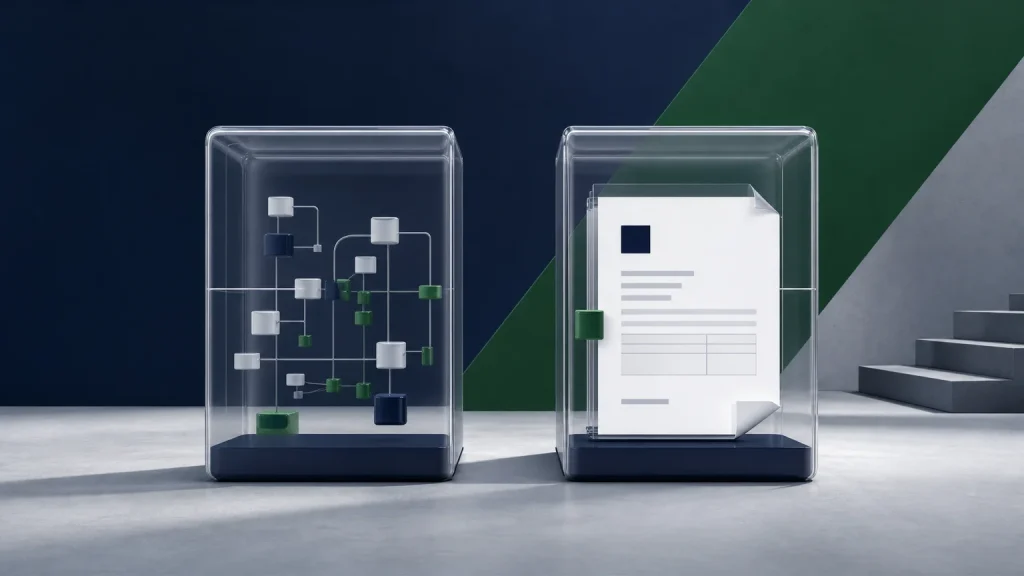
A PDF file is not automatically an e-invoice. However, “PDF is never an e-invoice” would also be wrong: A hybrid format such as ZUGFeRD combines a visible PDF invoice with embedded structured invoice data. The decisive factor is therefore not whether the file can be opened in the PDF program, but how the invoice information appears in it. The format developer FeRD explains this structure.
As of: 4 November 2026. This distinction matters for self-employed people and SMEs: the general transition period for issuing invoices ends on 31 December 2026. That does not mean that PDFs are completely banned or that any XML file will then be sufficient. The scope, exemptions and further transition rules in § 27 paragraph 38 UStG remain decisive.
The obligation described here generally applies to supplies to another business for its business purposes where both parties are established in Germany within the meaning of the law. Transactions exempt from VAT under § 4, numbers 8 to 29 UStG, are excluded from the corresponding obligation to issue e-invoices. Invoices to private consumers need to be considered separately from this B2B rule. The relevant provision is § 14(2) UStG.
Digitally readable is not the same as structured
An ordinary PDF invoice represents information for humans: invoice number at the top right, items in a table, total amount below. Even if text can be highlighted and copied, this alone does not meet the legal requirements. § 14 paragraph 1 UStG requires that an e-invoice is issued, transmitted and received in a structured electronic format and enables electronic processing. Other electronic invoice formats are regarded as other invoices.
Put simply, structured data has defined meanings and locations. Software does not first have to work out which number is the invoice number from font sizes or positions on the page. The law provides in particular for the European standard EN 16931 and its associated syntaxes. Other agreed formats are also permitted if they allow the required information to be extracted correctly and completely into a compliant or interoperable format. Source: gesetze-im-internet.de
Two invoices can look the same and be different
An illustrative example: A supplier sends two visually identical invoices. The first was only exported as PDF. The second is a properly generated ZUGFeRD invoice with a matching profile. Only the second one additionally contains the intended structured XML record. An XRechnung takes a different approach: it consists of XML and does not require an embedded PDF view. A suitable viewer makes its data readable for humans. The differences are explained by FeRD in its technical FAQ.
With ZUGFeRD, the version and profile also matter. As of version 2.0.1, the formats generally meet the VAT requirements; the MINIMUM and BASIC-WL profiles are excluded. The designation „ZUGFeRD“ alone is therefore not sufficient evidence of compliance. Nor does a file name such as “e-invoice.pdf” or any XML attachment prove that the specific file corresponds to the allowed format. Source: ferd-net.de
Why OCR does not turn a PDF into an e-invoice afterwards
OCR, or text recognition, can help with reading invoice data. However, extracting data from an ordinary PDF afterwards does not retroactively change the invoice issued and transmitted by the supplier. This follows from UStG § 14: the structure must already be present when the invoice is issued, transmitted and received. Internal data capture must therefore be distinguished from a properly issued e-invoice. Source: gesetze-im-internet.de
Our recommendation: If e-invoicing is required, request a suitable invoice or correction from the issuer, instead of converting the PDF yourself as a supposed original. The BMF describes the correction of an invoice issued in the wrong format by subsequently issuing an e-invoice with a clear reference to the original document. See BMF letter of 15 October 2024, paragraph 57.
What actually expires at the end of 2026
Until 31 December 2026, invoice issuers may still send other types of invoice for the relevant transactions carried out in 2025 and 2026; an ordinary PDF requires the recipient’s consent. For transactions carried out in 2027, this option continues until the end of 2027 if the issuer’s total turnover in the previous year was no more than EUR 800,000. Exactly EUR 800,000 is therefore included. An additional transitional rule covers certain EDI procedures. These are already applicable legal rules, not forecasts. Source: gesetze-im-internet.de
Exceptions include small-value invoices under UStDV § 33 with a total amount of up to and including EUR 250, travel tickets under UStDV § 34, and invoices for transactions exempt under the Kleinunternehmer scheme in UStG § 19(1), under UStDV § 34a. The small-value invoice rule does not apply to transactions under UStG §§ 3c, 6a and 13b. By contrast, businesses generally had to be able to receive e-invoices from 1 January 2025; an email inbox is sufficient for this. Receiving invoices and issuing your own are therefore separate matters. BMF 2025, paragraph 22, and BMF 2024, paragraphs 40 and 62, explain this distinction.
How to check your next incoming invoice
We recommend the following steps for your day-to-day work:
- Classify the file: Ordinary PDF, hybrid invoice or standalone XML file? Don’t rely solely on the file extension and preview.
- Check the structure: Use a suitable validation application for format and business rules. Keep the validation report with the invoice.
- Check the contents: Compare the supply, invoice recipient and amounts with the order and evidence of delivery or completion. Validation does not replace checking the substance of the invoice.
- Clarify discrepancies: In hybrid invoices, the structured part is authoritative. Conflicts with the PDF view should be clarified with the issuer before further processing.
- Keep original data: Do not keep only a printout or screenshot. At least the structured part must be retained intact in its original form.
The basis for these checks is set out in the BMF letter of 15 October 2025, particularly paragraphs 6a, 35a and 60 and section 14.4(3) UStAE. For the workflow, the key distinction remains: processing e-invoices means using structured original data, rather than simply storing a PDF preview. This overview does not replace advice on an individual case.
Sources
- Federal Ministry of Justice / Federal Office of Justice, Laws on the Internet: § 14 UStG – issuing invoices, current version of the law; accessed on 04.11.2026.
- Federal Ministry of Justice / Federal Office of Justice, Laws on the Internet: § 27 UStG – general transitional provisions, paragraph 38, current version of the law; accessed on 04.11.2026.
- Forum elektronische Rechnung Deutschland (FeRD): Technical information on e-invoicing, without a stated publication date; accessed on 04.11.2026.
- Federal Ministry of Finance: Introduction of mandatory electronic invoices for transactions between domestic entrepreneurs from 1 January 2025, letter of 15.10.2024, here taking account of the amendments of 15.10.2025; accessed on 04.11.2026.
- Federal Ministry of Finance: Introduction of mandatory electronic invoicing; adjustment of the VAT implementing decree, letter of 15.10.2025; accessed on 04.11.2026.
- Federal Ministry of Justice/Federal Office of Justice: § 33 UStDV – small-value invoices, current version of the regulation; accessed: 04.11.2026.
- Federal Ministry of Justice/Federal Office of Justice: § 34 UStDV – tickets as invoices, current version of the regulation; accessed: 04.11.2026.
- Federal Ministry of Justice/Federal Office of Justice: § 34a UStDV – invoices from businesses using the Kleinunternehmer scheme, current version of the regulation; accessed: 04.11.2026.